


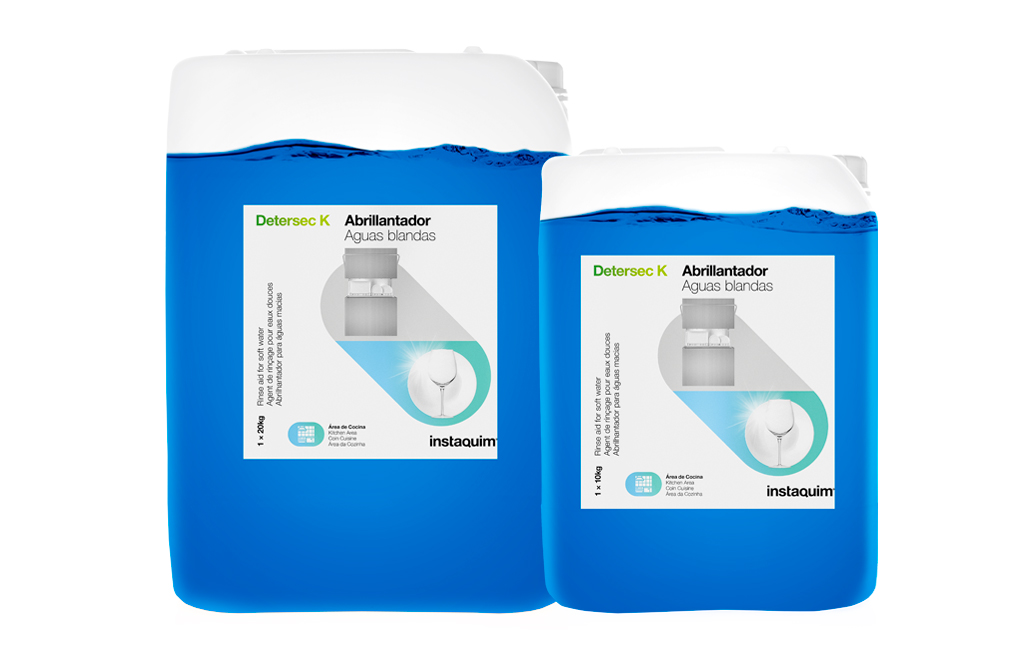
Detersec K
Rinse aid for soft water
Detersec K is a rinse aid for the final rinse in automatic dishwashing. It incorporates high-efficiency drying and anti-foaming agents, prevents the formation of limescale deposits and provides excellent shine and total transparency. It leaves no residual odours or tastes on the washed items.
Detersec K technical data
| Dosage and use instructions | Dosage ranges from 0.3 to 1 g/l, at a temperature between 65 and 80ºC. Automatic dosing is recommended for a better performance. |
|---|---|
| Technical data | Appearance: Transparent blue liquid. pH: 2.5 +/- 0.5 |
| Main components | Contains non-ionic surfactants 5-15 %. C10-C12-alcohol ethoxylated/propoxylated. |
| Presentation | 10 kg, 20 kg. |
B2B PRICE · MANUFACTURER
Need the B2B price for Detersec K?
We send you the price per pack size and the technical data sheet with the recommended dosage. We reply within 24 working hours.
Related products


Detersec K is a rinse aid for the final rinse in automatic dishwashing. It incorporates high-efficiency drying and anti-foaming agents, prevents the formation of limescale deposits and provides excellent shine and total transparency. It leaves no residual odours or tastes on the washed items.
Directions for use: Doses range between 0.3 and 1 g/l, at a temperature between 65 and 80 ºC. For improved performance, automatic dosing is recommended.
What is a rinse aid and how does it work?
A rinse aid is automatically dispensed during the final rinse phase of the dishwasher. Its technical function is to reduce the surface tension of the water: instead of clinging in droplets on plates, glasses and cutlery, the water spreads into a uniform film and sheets off the surface (sheeting effect). As the water drains away before drying, the dissolved minerals —mainly limescale— are prevented from crystallising on the dishes, eliminating spots, water marks and whitish films, especially visible on glassware. The result is faster drying, with no manual wiping, and a bright, streak-free finish. The optimal dose depends on water hardness: the harder the water, the higher the dose needed to offset the lime content.