


Deterdry
Rinse aid for very hard water and glassware
Rinsing additive for use in the last rinse in automatic dishwashing. Specially designed for water with high conductivity. Incorporates high-efficiency drying and anti-foaming agents. This product has high anti-scaling power which helps eliminate the cloudiness and stains produced by hard water. Does not produce foam. Does not leave residual smells or flavours that could contaminate the washed items. Also suitable for ovens with automatic washing systems.
Deterdry technical data
| Dosage and use instructions | Dosage ranges from 0.1 to 1 g/l, at a temperature between 65 and 80ºC. Automatic dosing is recommended for a better performance. |
|---|---|
| Technical data | Appearance: Transparent red liquid. pH: 2.0 +/- 0.5 |
| Main components | Contains non-ionic surfactants 5-15 %. |
| Presentation | 10 kg, 20 kg, 4x5 kg. |
B2B PRICE · MANUFACTURER
Need the B2B price for Deterdry?
We send you the price per pack size and the technical data sheet with the recommended dosage. We reply within 24 working hours.


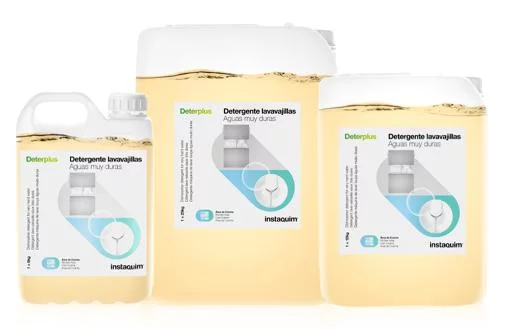


Deterdry is a professional rinse aid for hard water formulated for automatic dishwashers in facilities with elevated water hardness. It acts in the final rinse by inhibiting the adhesion of mineral deposits on glassware, tableware and internal equipment surfaces, helping to eliminate the characteristic white film of hard water.
Description
Deterdry is a professional rinse aid and anti-scale product specifically designed for automatic hood or tunnel dishwashers in environments with hard water. Its formulation incorporates high-efficiency drying and anti-foaming agents, with a high anti-scaling power that acts during the final rinse, preventing the precipitation of mineral salts on glassware, tableware and equipment internal surfaces. The result is a brilliant finish without white film.
Formulated and manufactured by Detervic / Instaquim, Deterdry is designed for high-intensity use installations in hospitality, collective catering and industrial kitchens.
| Product summary | |
|---|---|
| Product type | Rinse aid and anti-scale for automatic dishwasher |
| Main use | Final rinse in hood or tunnel dishwashers in hard water areas |
| Sectors | HoReCa, collective catering, healthcare, industrial canteens |
| Application | Automatic dosing recommended (0.1 – 1 g/l at 65-80 ºC) |
| Documentation | Technical sheet available |
Benefits for professional use
- Enhanced anti-scale action — high anti-scaling power, specially designed for water with high conductivity.
- White film elimination — helps eliminate the cloudiness and stains produced by hard water on glassware and tableware.
- High-efficiency anti-foaming — does not produce foam.
- No residual odours or flavours — does not leave residual odours or flavours that could contaminate the washed items.
- Adjustable dosing — range of 0.1 to 1 g/l.
Main applications
- Glassware and tableware in restaurants and hotels: hood dishwashers in kitchens with high mineralisation water.
- Collective catering with tunnel dishwashers: hospitals, residential homes and company canteens with variable water supply depending on municipal source, where hardness may fluctuate.
- Ovens with self-cleaning system: compatible with self-washing cycles; low foam generation prevents interference in the equipment's internal ducts.
- Installations in high water conductivity areas: specially designed for water with high conductivity.
Recommended sectors
- HoReCa — hotels, restaurants and cafés with intensive washing of glassware and tableware in kitchens with hard high-hardness water; especially in areas where municipal water hardness exceeds average values.
- Healthcare and geriatric care — collective catering in hospitals and residential homes with tunnel dishwashers, where water minerals generate persistent deposits on tableware and trays.
- Service companies and facility management — management of washing protocols in corporate canteens and centralised kitchens with water supply varying by installation.
Indicative instructions for use
Specific dilutions, contact times and recommendations are available in the product technical sheet.
Specialist product versus generic alternative
| Aspect | Deterdry | Generic product |
|---|---|---|
| Application | Specifically formulated for automatic dishwashers in high mineralisation hard water areas | More general use, not adapted to high hardness |
| Anti-scale efficiency | High anti-scaling power, designed for water with high conductivity | Variable depending on formulation |
| White film on glassware | Helps eliminate cloudiness and stains | Variable depending on formulation |
| Foam | Does not produce foam; high-efficiency anti-foaming agents | Variable depending on formulation |
| Technical documentation | Technical sheet available | May depend on supplier |
| Support | Manufacturer with technical department (Detervic / Instaquim) | Reseller or brand without direct support |
| Channel adaptation | Distributor rate and professional formats | Frequently retail format |
Frequently asked questions
What is Deterdry used for?
Deterdry is a rinse aid and anti-scale product for automatic dishwashers formulated for hard water areas. It acts in the final rinse by preventing the precipitation of calcium and magnesium salts on glassware, tableware and equipment internal surfaces, helping to eliminate the cloudiness and stains produced by hard water.
Which sectors is it recommended for?
It is especially recommended in hospitality and catering (hotels, restaurants, cafés), collective catering (hospitals, residential homes, company canteens) and any installation with automatic hood or tunnel dishwasher in areas where water hardness generates persistent finish problems.
What is the recommended dose?
The indicative dosing is 0.1 to 1 g/l, at a temperature between 65 and 80 ºC. For precise specifications, consult the technical sheet.
Is it suitable for professional use?
Yes. Formulated by Detervic / Instaquim for high-intensity professional environments, with technical support for distributors and authorised users.
Where can I consult the technical sheet?
Available on this page. For specific dilutions, temperature ranges and detailed operational recommendations, consult the complete technical document.
Is the safety sheet available?
Yes. The safety data sheet (SDS) is available to authorised customers and distributors upon request to the commercial department.
How can I request a quote or rate?
Contact the commercial team via form, WhatsApp or telephone. We respond to enquiries within 24 business hours.
What is a rinse aid and how does it work?
A rinse aid is automatically dispensed during the final rinse phase of the dishwasher. Its technical function is to reduce the surface tension of the water: instead of clinging in droplets on plates, glasses and cutlery, the water spreads into a uniform film and sheets off the surface (sheeting effect). As the water drains away before drying, the dissolved minerals —mainly limescale— are prevented from crystallising on the dishes, eliminating spots, water marks and whitish films, especially visible on glassware. The result is faster drying, with no manual wiping, and a bright, streak-free finish. The optimal dose depends on water hardness: the harder the water, the higher the dose needed to offset the lime content.